Multi-Unit Brand Drift: The Month-4 Inflection Point Luxury F&B Operators Never See Coming
Why the second and third site diverge from the first, and the weekly operating model that catches it in week 2.
The second site of a luxury independent F&B group opens on schedule, the opening team runs it for six weeks, the numbers look strong, and the group founder flies back to site 1. Month 4 arrives and the group accountant pulls the comparative P&L. Site 2 revenue is within 5 percent of site 1 — good number, on trend. But the guest-satisfaction survey aggregate is 11 points lower than site 1. The online reviews have slipped from 4.6 average to 4.3 in month 4 specifically. Three trusted regulars who bridge both sites have mentioned, independently, that "the magic is only at the original."
The technical term for what has happened is brand drift. The guest term is "it is not the same." And the operator term — the one used in stairwells and service cars — is "we lost it without noticing."
This dispatch sets out the month-4 inflection point as we actually observe it in luxury independent groups: why it lands in month 4 specifically, what to do about it at week 2 of the new site's operation (not month 4 when the damage is already pattern), and the operating model that holds service texture across 2 to 5 sites without the infrastructure a chain would use.

Why drift lands in month 4, not month 2 or month 6.
Three structural factors converge at month 4 to produce the inflection.
Factor one — the opening-team rotation departs. The senior operators from site 1 who were present daily at site 2 for the first 60-90 days have rotated out by day 90. The site is now running on local leadership, often for the first time without daily oversight from the founder or the original GM. The skills gap is not visible immediately because the team still remembers what good looks like. It becomes visible around day 100-110 when the memory of specific service moments starts to fade and the team begins to improvise.
Factor two — the first cycle of local hires completes onboarding. The opening team hired a fully-staffed roster from a mix of site-1 transfers and local recruits. By month 4, local recruits who passed the 90-day onboarding are now running sections, sometimes leading shifts. These people are competent — that is why they passed — but they were trained on the documented version of the service, not the textural version. The textural version is what the senior team from site 1 held in their heads but never wrote down.
Factor three — the founder's attention shifts. By month 4, site 2 is "open and running." The founder's next project — often site 3, or a concept pivot, or an investor presentation — captures attention. Weekly visits to site 2 become fortnightly. Monthly P&L review replaces daily Slack updates. This is not neglect; it is normal founder bandwidth allocation. But it removes the single most important feedback loop: the founder walking the room and noticing, without a framework, that the light at the host stand is too warm tonight and the music is three bpm too fast.
Month 2 is too early — the opening team is still present.
Month 6 is too late — the pattern has crystalised into habit.
What drifts first — and what drifts last.
The sequence of what drifts is more consistent than most operators expect. If you know the order, you can catch it one phase earlier than the P&L signal would.
Phase 1 — Plating tolerance widens (days 60-90)
The executive chef's plating reference photos from site 1 are in a shared drive. The line cooks at site 2 have seen them. But the pass-level discipline — the chef standing at the pass sending back a plate 1 centimetre off the reference — is inconsistent. Plates start leaving the pass with 1-2cm variance. The guest does not consciously notice. But the cumulative effect on the room is a reduction in the perceived-precision signal that is the core of a luxury plate.
Phase 2 — Service-timing choreography loosens (days 90-110)
The 30-second pause between courses, the 7-second wine-pour discipline, the three-beat silence before the specific phrasing of a table greeting — all of these are textural. None of them are in the SOP binder. They were transmitted through shadowing during the opening period. By day 100, local staff who were not present during that transmission are running the section. They are doing the words right and the mechanics right, but the timing is 15-25 percent faster than site 1. The room reads as slightly less elegant without anyone being able to point to why.
Phase 3 — Menu stability erodes (days 110-130)
Unplanned 86s. A specialty ingredient out of stock for three days before procurement catches up. A plate modified to compensate that becomes the new version for a week. A beverage pairing that was specific to site 1's inventory is substituted at site 2 with a near-equivalent that is, in fact, inferior. Individually these are minor. In aggregate they represent the menu's drift from its locked version.
Phase 4 — Team language shifts (days 120-140)
The specific phrasing for VVIP recognition. The internal code for a table that needs attention. The operator jargon that is part of the group's identity. By month 4 the local team has developed its own vocabulary — sometimes better, sometimes worse, but different. When a founder or senior operator arrives for the monthly visit, the vocabulary drift is the first thing they notice, and it is always the most advanced phase of drift, not the earliest.
Phase 5 — Financial signal (month 5-6)
By the time the comparative P&L and the online-review aggregate show drift, the first four phases are 60-90 days old. Phase 5 is the lagging indicator. Operators who wait for it have already lost the month where the drift could have been corrected inexpensively.
The week-2 check — the single mechanism that catches drift before it starts.
There is one operating rhythm that catches drift at phase 1, before any of the later phases compound: the week-2 check, run by a senior operator from site 1, physically present at site 2, observing for a full dinner service without speaking.
It runs fortnightly from day 14 onwards, not monthly. The fortnightly cadence is not arbitrary — it matches the phase-1-to-phase-2 transition window, which is the earliest point at which drift is detectable and still free to correct.
The four observation windows
Each check produces four pieces of documented output within 6 hours of the service:
- The 3-plate audit. Three dishes plated over the course of one service, photographed from overhead with a reference ruler in the frame, compared against the site-1 reference. Variance under 1cm: green. 1-2cm: yellow. Over 2cm: red — correction conversation with the executive chef the next morning.
- The timing capture. Two tables observed from arrival to dessert, with course intervals and key service moments logged. Variance under 10 percent from site-1 timing spec: green. 10-20 percent: yellow. Over 20 percent: red.
- The menu integrity log. Every 86 noted, every substitution observed, every modified preparation captured. Weekly 86 count over 3: yellow. Any modification running more than 48 hours without correction: red.
- The language snapshot. Three greeting phrasings, three service handoffs, and one VVIP recognition captured verbatim. Compared against site-1 scripts. Any meaningful divergence from locked phrasing: yellow.
Caught at week 2, drift costs a 20-minute correction conversation.
Caught at month 4, drift costs a 14-day re-training intensive and 90 days of review recovery.
What this does not require.
It does not require a chain-operator infrastructure. No centralised training department. No branded audit-team roles. No 200-page operations manual. Luxury independent groups that try to build chain-grade consistency infrastructure end up with something that does not fit their service texture and is not used — the binder sits in a drawer and drift happens anyway.
What it requires is one senior operator with apprenticeship-grade knowledge of site 1's texture, four hours every fortnight for the first six months, and a brand bible that documents the texture-dependent details (phrasing, timing, plating reference photos) not just the SOPs. The operating model is apprenticeship plus weekly audit, not SOP distribution plus periodic audit. Those are two different systems.
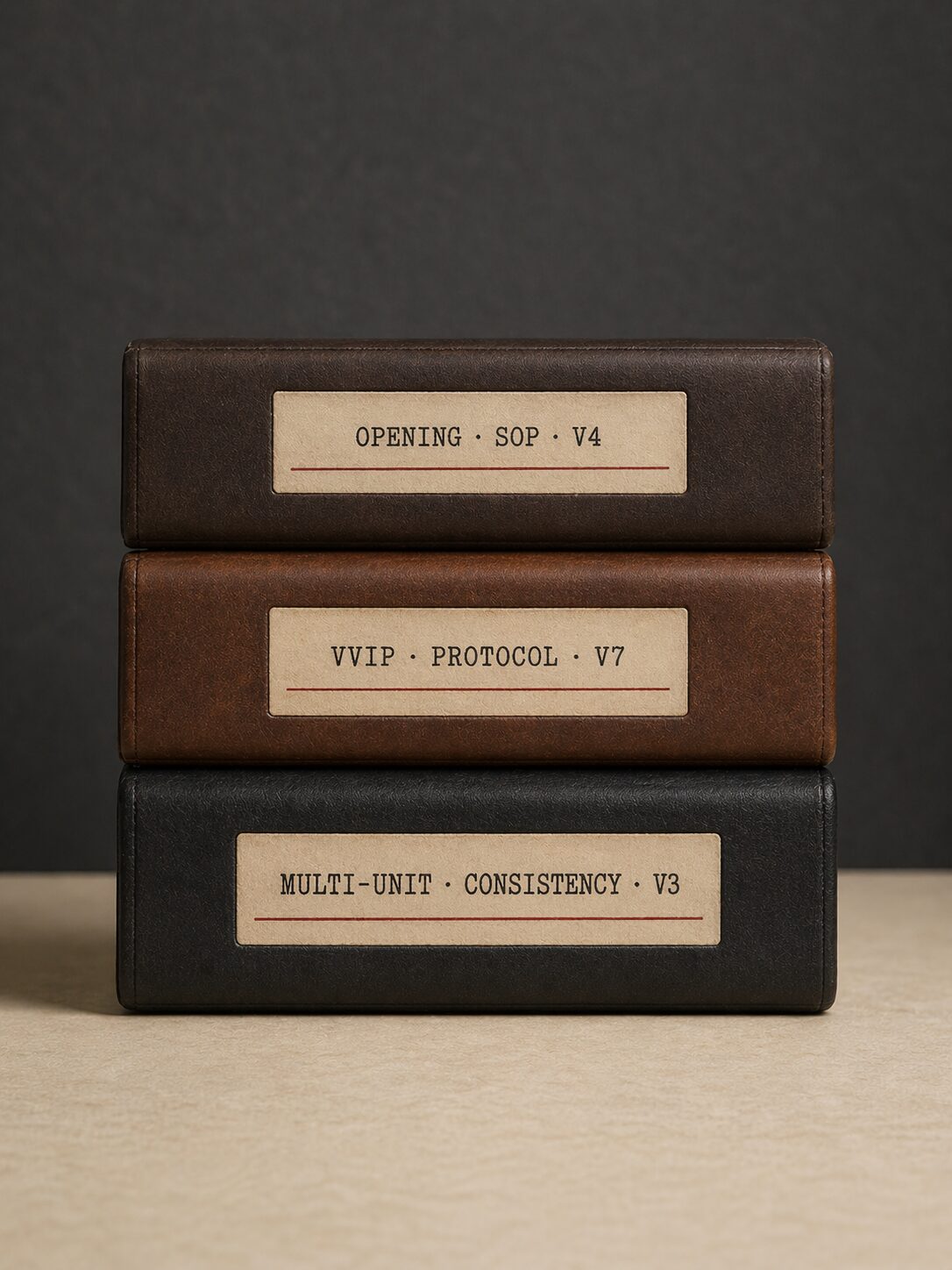
The full OPERATOR BUNDLE includes the Multi-Unit Consistency Framework playbook (22 pages) with the brand bible template, the week-2 check scripts, the 3-observer quarterly review protocol, and three worked case sketches of multi-unit rollouts that drifted (and one that held). Bundled with the 90-Day Critical Path and the VVIP Recovery Playbook for $129.
Related reading.
If you have not read the free chapter of the 90-Day Critical Path — Week 9 Is Where It Breaks — it is at operatorside.com/free-chapter. 9 pages, no signup. Pre-opening failure patterns for operators 90-180 days from a launch.
Previous dispatch: The 90-Day Restaurant Opening Checklist (Operator-Tested) — the five phases of the pre-opening critical path and the 12-item audit that runs at T-49.
FAQ
What is brand drift in multi-unit luxury hospitality?
Brand drift is the measurable divergence between the service standard, product execution, and guest experience of a venue's second or third site and the original flagship. In luxury independent groups, drift appears first in small details — plating inconsistency, beverage-program inventory decisions, service-timing variance — and by month 6 reaches the level where the two sites read as sibling brands rather than the same brand. Drift is not a failure of loyalty; it is the natural entropy of any operating system without a deliberate holding mechanism.
When does brand drift typically start in a new venue rollout?
Drift starts between day 60 and day 90 of the second site's operation, becomes measurable at month 4, and crystalises by month 6. The month-4 inflection is consistent across luxury independent groups because it is the first month after the opening-team rotation departs the second site and local leadership is running it solo. Groups that catch drift at week 2 — using the weekly check described in this dispatch — hold the standard through month 12 and beyond. Groups that catch it at month 4 spend the next 12 months recovering what was lost.
How is multi-unit consistency different between luxury and mid-market operators?
Mid-market chains rely on centralised SOP distribution and periodic audit to enforce consistency. This works at their service standard because the details are simple enough to codify in a 40-page binder. Luxury independent groups cannot use this model because the service details are texture-dependent — the 30-second pause in wine pour timing, the specific phrasing of a VVIP recognition, the stemware swap decision — and these do not compress into a binder. The luxury model is apprenticeship-plus-weekly-audit: senior operators from site 1 physically present at site 2 for 14 days, weekly texture-check afterwards, quarterly 3-observer review.
What is the OPERATOR SIDE Multi-Unit Consistency Framework?
The Multi-Unit Consistency Framework is a 22-page playbook documenting the brand bible structure, SOP version control system, the week-2 check protocol, and the operating model that holds service standard across 2-5 sites of a luxury independent group. It is part of the Operator Bundle ($129) alongside the 90-Day Critical Path and the VVIP Recovery Playbook. It is written for groups expanding from site 1 to site 2 or site 2 to site 3 — not for chain operators with internal playbook already in place.
Can I prevent brand drift entirely?
No. Entropy is the default state of any distributed operating system. What you can do is make drift visible early enough to correct it cheaply — weekly at month 1-3, fortnightly at month 4-6, monthly after that. The weekly 3-table check described in the 90-Day Critical Path playbook catches 70-80 percent of drift before it compounds into pattern. The remaining 20-30 percent needs the outside-observer protocol (a senior operator from a peer venue, visiting quarterly, reporting privately to the operator).